


The California statute of limitations is the deadline to start a criminal case. It runs one year for misdemeanors, three years for most felonies, six years for offenses punishable by eight or more years, and has no limit for murder and listed sex offenses. Your freedom, career and family are at stake, and a charge does not define you.
The deadline follows the offense’s maximum punishment under PC § 805, as written in the penal code sections for each crime, not the label on the complaint. In Alameda County, the District Attorney files in Alameda County Superior Court at the René C. Davidson Courthouse in Oakland.
California Sets Deadlines By Maximum Punishment.
California sets four tiers under PC §§ 799-802. Each tier turns on the most punishment the statute allows.
- PC § 802(a), one year: covers any offense not punishable in state prison or under PC § 1170(h), meaning misdemeanors and infractions.
- PC § 801, three years: covers other felonies, meaning crimes punishable in state prison or county jail under § 1170(h).
- PC § 800, six years: covers offenses with a maximum term of eight years or more.
- PC § 799, no limit: covers murder and other death or life offenses, embezzlement of public money, and listed violent sex offenses.
PC § 805 sets the period by the maximum punishment in the statute. County-jail felonies under § 1170(h) count as felonies, and enhancements are ignored. The difference between infractions, misdemeanors and felonies drives every row below.
Statute Of Limitations Chart For Common California Offenses.
Each row ties an offense to its Penal Code section, period and clock trigger.
- PC § 243(e)(1) domestic battery: misdemeanor, § 802(a), one year, offense date.
- PC § 273.5 corporal injury: wobbler, § 801, three years, offense date.
- PC § 273.6 protective order violation: misdemeanor in most cases, § 802(a), one year. Felony versions get three years under § 801.
- PC § 646.9 stalking: wobbler, § 801, three years, offense date.
- PC § 261 rape: felony. Listed force-based subdivisions have no limit under § 799(b). Other subdivisions get 10 years under § 801.1(b).
- PC § 288(a) lewd act on a child under 14: felony, § 801.1(a), before the victim’s 40th birthday.
- PC § 288.5 continuous sexual abuse: felony, § 799(b), no limit.
- PC § 261.5 unlawful sex with a minor: misdemeanor under (b), one year under § 802(a). Wobbler under (c) or (d), three years under § 801.
- PC § 243.4 sexual battery: felony version under (a), 10 years under § 801.1(b). Misdemeanor under (e), one year.
- PC § 647.6 annoying a minor: misdemeanor, § 802(b), three years.
- Vehicle Code § 23152 DUI: misdemeanor, one year under § 802(a). Felony DUI with priors gets three years under § 801.
- Vehicle Code § 23153 DUI causing injury: wobbler, § 801, three years.
- PC § 487 grand theft: wobbler, § 801, three years from the offense date. Fraud-based grand theft gets four years from discovery under §§ 803(c) and 801.5.
These rows reflect the code as of November 2026. Statutes change, so our team checks the current text in every case.
The Limitations Clock Runs From Offense To Filing.
The clock starts on the offense date and stops when the prosecution is commenced under PC § 804. Your arrest date does not count.
Offense Date Starts The Clock.
The clock starts on the date of the offense. PC § 803(c) starts it at discovery for felonies built on fraud, breach of a fiduciary duty, or theft from an elder.
Take two grand thefts under PC § 487. A shoplifted item stolen in May 2023 starts the clock in May 2023. Funds embezzled in 2023 and found in an audit in 2025 start the clock at discovery in 2025.
Commenced Means Filed Under PC 804.
A prosecution is commenced under PC § 804 when the DA files an indictment, an information, or a misdemeanor complaint, or when an arrest warrant naming you issues. For a felony complaint, arraignment on that complaint also counts.
The filing or warrant date in the Alameda County Superior Court record is the date that counts. A warrant issued the day before the deadline is timely, even if the arrest comes months later.
Absence From California Pauses PC 803(d).
Time spent outside California pauses the clock under PC § 803(d). The extension is capped at three years, so even a five-year absence adds no more than three.
Worked Examples Under PC 804.
The method is three steps.
1. Offense date: find it in the police report or complaint.
2. Period: add the years set by §§ 799 to 802.
3. Filing date: compare against the complaint, information or warrant date.
- PC § 273.5 on March 15, 2023: three years under § 801 sets the deadline at March 15, 2026. A complaint filed March 16, 2026, with no earlier warrant, is late.
- PC § 243(e)(1) on June 1, 2025: one year under § 802(a) sets the deadline at June 1, 2026.
- Same battery, but the person lived out of state for 18 months: § 803(d) adds those 18 months, moving the deadline to December 1, 2027.
Domestic Violence Deadlines Depend On The Charge.
Domestic violence has no single deadline. Misdemeanor battery gets one year, while corporal injury and stalking, which can be charged as felonies, get three.
Under PC § 805, the statute’s maximum punishment controls, not the word on the complaint. Our work defending domestic violence charges starts with that check.
Misdemeanor Battery Under PC 243(e)(1)
Misdemeanor domestic battery under PC § 243(e)(1) has a one-year deadline under PC § 802(a). It runs from the offense date.
Under CALCRIM No. 841, the prosecution must prove a willful, harmful or offensive touching of a spouse, partner, or similar close relation. The penalty runs up to one year in county jail and a fine up to $2,000. Our page on how domestic battery is defined covers the elements.
Misdemeanor protective order violations under PC § 273.6 also get one year.
Wobbler Corporal Injury Under PC 273.5
Corporal injury under PC § 273.5 is punishable in state prison, so the three-year period in PC § 801 applies. A wobbler is an offense chargeable as a felony or a misdemeanor.
Under CALCRIM No. 840, the prosecution must prove a willful injury causing a traumatic condition to a partner. Felony penalties run two, three or four years in state prison. Stalking under PC § 646.9 is also a wobbler with three years.
PC 17(b) Reduction Leaves Three Years.
Charging a 273.5 as a misdemeanor, or later reducing it under PC § 17(b), does not shorten the felony period. Section 805(a) measures the maximum punishment, whatever punishment is sought or imposed.
PC § 17(b) lets a court declare a wobbler a misdemeanor. Say the offense happened January 10, 2024, and the DA files a misdemeanor 273.5 on February 1, 2025. The filing is timely under § 801, and the controlling authority is the text of § 805(a) itself.
A 243(e)(1) is different. Its maximum is county jail, so one year applies. Reducing a felony charge changes your record, not the filing deadline.
California Sex Crime Deadlines Follow A Set Order.
Apply four checks in order. First PC § 799 (no limit), then whether the deadline expired by January 1, 2017, then PC § 801.1 (minor victims), then PC §§ 800-802.
Rape under § 261 and continuous abuse under § 288.5 can stop at the first check. Misdemeanor sexual battery falls through to one year under § 802(a). Knowing your rights when falsely accused begins with these dates.
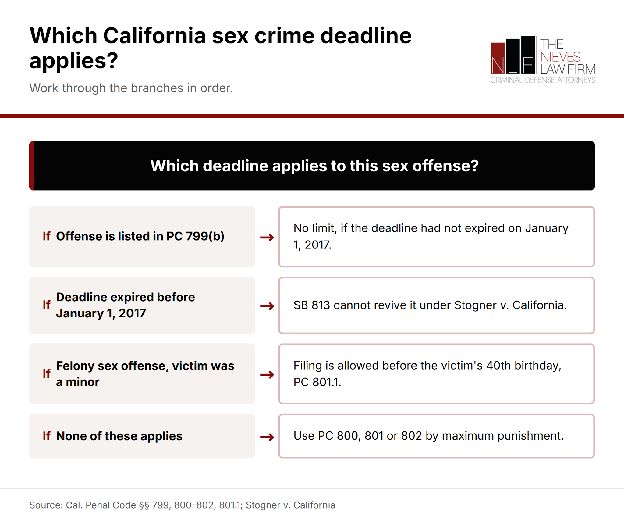
Figure 1: Check PC 799 first, then the 2017 cutoff, then the minor-victim rule. Source: Cal. Penal Code §§ 799, 800–802, 801.1; Stogner v. California.
Check PC 799 First.
PC § 799, as amended by SB 813, removes the limit for listed violent sex offenses such as rape under PC § 261 and PC § 264.1. There are seven groups in § 799(b).
- Rape under listed § 261 subdivisions: intercourse by force, fear, threat, or with an intoxicated or unconscious person.
- Rape in concert under § 264.1: rape committed with another person’s help.
- Sodomy under listed § 286 subdivisions: by force or with an incapacitated person.
- Oral copulation under listed § 287 subdivisions: by force or with an incapacitated person.
- Sexual penetration under listed § 289 subdivisions: by force or with an incapacitated person.
- Lewd acts by force under § 288(b): a lewd act on a child by force or fear.
- Continuous sexual abuse under § 288.5: repeated abuse of a child over three months or more.
Under CALCRIM No. 1000, the prosecution must prove intercourse without consent, accomplished by force, fear or threat.
SB 813 Cannot Revive Expired Cases.
SB 813 cannot revive an expired case. It took effect January 1, 2017 and applies only to cases not already time-barred.
In Stogner v. California (2003), the U.S. Supreme Court held that reviving an expired limit violates the ex post facto clause. If the old deadline ended before January 1, 2017, the case stays closed.
PC 801.1 Extends Minor Victim Cases.
For listed felony sex offenses against a minor, PC § 801.1(a) allows filing before the victim’s 40th birthday. Other registrable felony sex offenses get 10 years under § 801.1(b).
PC § 803 adds narrow extensions, such as filing within one year after DNA testing conclusively identifies a suspect. Offenses outside these rules fall back to §§ 800, 801 and 802.
California Courts Require The Prosecution To Prove Timeliness.
The defense raises a late filing by demurrer, a motion to dismiss, or a PC § 995 motion. The prosecution must then show timeliness by a preponderance, under People v. Zamora (1976) 18 Cal.3d 538.
A demurrer challenges the complaint on its face. A § 995 motion asks the court to set aside an information. Late filings sometimes surface during a dismissal at a preliminary hearing.
California treats the limit as jurisdictional. Silence at trial does not forfeit it, per People v. Williams (1999). Under Cowan v. Superior Court (1996), you can expressly waive it to plead to a time-barred lesser offense, which gives up the defense.
Misreading The Statute Of Limitations Costs Options.
Five mistakes recur, and each changes the answer. Other deadlines also get confused with this one.
Five Common PC 805 Deadline Mistakes.
Each mistake below shifts the deadline math.
- Measuring from arrest: § 804 uses the filing or warrant date, so the math comes out wrong.
- One year for a wobbler: § 805(a) gives a 273.5 three years under § 801.
- Applying 2017 to expired cases: Stogner keeps a pre-2017 expired case closed.
- Ignoring later-discovered offenses: a different offense from the same act carries its own period, and § 803(c) may start it at discovery.
- Treating it as speedy trial: § 1382 governs delay after filing, not the filing itself.
Other Deadlines Differ From PC 799-805.
The criminal statute of limitations limits when the state may file. Speedy trial, civil claims and federal limits answer different questions.
- Criminal statute of limitations, PC §§ 799-805: when California may file charges.
- Speedy trial, PC § 1382 and the Sixth Amendment: how long the state may delay after filing.
- Civil childhood sexual assault, CCP § 340.1: a separate lawsuit for money damages.
- Federal default, 18 U.S.C. § 3282: five years for most federal crimes.
Frequently Asked Questions
Do Sentencing Enhancements Change The Deadline?
No. PC § 805 sets the period by the offense’s maximum punishment and disregards enhancements. Enhancements add time at sentencing but do not lengthen the filing period.
Does DNA Extend The Deadline?
Yes, for certain felony sex offenses listed in PC § 290(c). PC § 803 allows filing within one year after DNA testing conclusively identifies the suspect. The biological evidence must have been tested within the deadlines the statute sets.
We Check Your Dates Against The Code.
A charge filed years later can feel unfair. A charge is not a conviction, and it does not define you. At The Nieves Law Firm, APC, you speak with our intake team first, Keydon Levy and Ebony Caraballo, then an attorney, with legal support behind every hearing.
Our Oakland team checks the offense date, the filing date, the governing section and any tolling. Managing Attorney Darryl Stallworth has tried 60+ jury trials, and our work defending sex crime charges starts with those dates. For people who have too much to lose.
