

A background check company generally cannot report a California misdemeanor conviction more than seven years after disposition, release or parole. Three tools protect you: the seven-year reporting limit, the Fair Chance Act, and post-conviction relief that changes the record itself.
An old conviction can stall a job search years after the case closes. It does not define you.
The federal Fair Credit Reporting Act (FCRA) lets agencies report convictions indefinitely. California is stricter. This post covers misdemeanors, not felonies, and sorts the rules by situation so you can see which tool fits.
Seven-Year Reporting Limit On California Misdemeanors
The limit bars consumer reporting agencies and investigative consumer reporting agencies from reporting a conviction more than seven years after disposition, release or parole. Civil Code 1785.13 and 1786.18 create it.
Most employment screens are investigative consumer reports. That makes Civ. Code 1786.18 the usual route for a job check.
The limit applies to any conviction. This post follows the misdemeanor path.
When The Seven-Year Clock Starts
The clock starts at disposition, release or parole, not at the offense or arrest date. For most misdemeanors, disposition means the sentencing date.
Take misdemeanor petty theft under Penal Code 488, sentenced Feb 14, 2018. Petty theft carries up to six months in county jail and a fine up to $1,000 under Penal Code 490.
That conviction passed the seven-year point on Feb 14, 2025. A report ordered today, Nov 10, 2026, should leave it out unless an exception applies.
A 2021 conviction stays reportable until 2028, counted from the exact disposition date. Our guide on how long a misdemeanor stays on your record covers the rest of the timing.
Unsure of your disposition date? Read your case on the court’s online docket.
The sentencing entry is the date the clock runs from under Civ. Code 1785.13 and 1786.18.
Who The Seven-Year Rule Binds
The rule binds reporting agencies, not employers. An employer who learns of an older conviction another way is not barred by Civ. Code 1785.13 or 1786.18.
A reference, a news story or your own answer can still surface an old conviction. Other laws limit what employers do with it. Labor Code 432.7 and the Fair Chance Act apply no matter how old the conviction is.
Exceptions To The Seven-Year Limit
There are two main exceptions: jobs above a statutory salary threshold, and positions where the law requires a fingerprint-based check.
The reporting statutes exempt employment at or above a set annual salary. The dollar figure and the items it reaches sit in the statute’s current text. Read that text before relying on a number.
Jobs in schools, healthcare and childcare can require a Live Scan fingerprint check through the California Department of Justice. Those checks sit outside the consumer report rules. Age alone does not keep a conviction off them.
Fair Chance Act Limits On Misdemeanor Questions
Under Gov. Code 12952, California employers with five or more employees cannot ask about conviction history until after a conditional job offer. People call it the ban-the-box law.
The bar covers application forms, interviews and any background check run before the offer.
You owe no answer about a misdemeanor before the offer. After the offer, answer truthfully. A false answer gives the employer a separate reason to withdraw.
What Employers Cannot Consider
Employers cannot consider arrests that did not lead to a conviction, diversion, or sealed or dismissed convictions. Labor Code 432.7 and Gov. Code 12952 both set this limit.
Labor Code 432.8 adds a rule for certain marijuana convictions more than two years old. Employers cannot ask about them or use them.
A conviction dismissed under Penal Code 1203.4 falls in the protected group. That is one reason record relief matters for private jobs.
Steps Before Rescinding A Job Offer
An employer must complete four steps after a conditional offer and before pulling it: an individualized assessment, a written preliminary notice, a response window, and a written final notice. Gov. Code 12952 and 2 CCR 11017.1, effective Oct 1, 2023, set this order.
1. Individualized assessment: the employer weighs the nature and gravity of the offense, the time elapsed, and the job’s duties.
2. Preliminary notice: a written notice names the conviction behind the decision.
3. Response window: you get at least five business days to respond, plus five more if you dispute the record’s accuracy.
4. Final notice: a written notice states your right to complain to the Civil Rights Department, formerly DFEH.
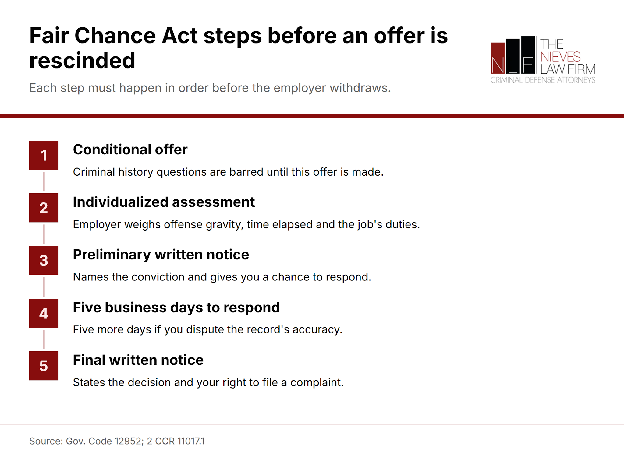
Figure 1: An employer that skips a step may have broken the Fair Chance Act. Source: Gov. Code 12952; 2 CCR 11017.1.
You have three years to file a complaint with the Civil Rights Department. Keep every notice and its date.
Penal Code 1203.4 Dismissal On Background Checks
A Penal Code 1203.4 dismissal, commonly called expungement, lets you answer no to conviction questions on most private job applications. The record still shows the conviction, now marked dismissed under 1203.4.
Know what expungement actually does before you answer any application. You must still disclose the conviction when you apply for public office, a state or local license, or a State Lottery contract.
The conviction can still be pleaded as a prior in a later case. A DUI dismissal under Vehicle Code 23152 leaves the DMV record intact and still counts as a prior for later DUI sentencing.
The common mistake is answering no on a licensing or government application. That answer can lead to denial or discipline for a false statement.
You petition the court where you were convicted after probation or sentence is complete, under PC 1203.4 or 1203.4a. For an Alameda County case, that means Alameda County Superior Court.
Automatic Relief Under Penal Code 1203.425
Penal Code 1203.425 is automatic conviction relief. The California DOJ identifies eligible misdemeanor convictions, and relief applies without a petition.
AB 1076 created it, and SB 731 expanded it. The DOJ flags misdemeanor convictions from Jan 1, 1973 onward where probation ended without revocation, or one year passed after judgment with no probation. A pending case blocks relief.
A 1203.4 dismissal needs a filed petition and a judge. 1203.425 relief runs through the DOJ with no filing.
Sex offenses requiring registration under Penal Code 290 are excluded. Other exclusions apply too.
You may already have relief and not know it. Request your own DOJ record review through Live Scan fingerprinting. The response shows whether relief was applied.
Which Protection Fits Your Misdemeanor?
The seven-year limit binds reporting agencies, the Fair Chance Act binds employers, and Penal Code 1203.4 and 1203.425 change the record itself. Your facts decide which one helps.
- Under seven years old, probation complete: petition for a Penal Code 1203.4 dismissal.
- Still on probation: ask about ending probation early, since a 1203.4 petition waits until probation ends.
- Over seven years old: pull your report and dispute any entry the limit bars.
- Licensing application: relief may not help, because you must still disclose the conviction.
| Protection | Binds | What it does | Trigger | What still shows |
|---|---|---|---|---|
| Seven-year limit | Reporting agencies | Blocks reporting older convictions | Seven years from disposition, release or parole | Exempt jobs; employer-learned information |
| Fair Chance Act | Employers, 5+ employees | Delays questions; requires assessment | Conditional job offer | Conviction, if assessment allows |
| PC 1203.4 dismissal | Court order | Allows no-conviction answers, private jobs | Petition after completed probation | Licensing, public office, priors |
| PC 1203.425 | DOJ, automatic | Relieves eligible misdemeanors | DOJ identifies eligible records | Excluded offenses stay |
Figure 2: Each protection covers a different gap, so one rarely replaces the others. Source: Civ. Code 1785.13, 1786.18; Gov. Code 12952; Penal Code 1203.4, 1203.425.
Disputing Outdated Entries With Background Check Companies
You dispute an outdated entry by requesting your report, flagging items over seven years old or dismissed, and filing a written dispute with the agency. Federal FCRA gives the agency 30 days to investigate.
1. Request your file: ask the agency for it under Civ. Code 1786.22.
2. Flag entries: mark convictions past seven years and any dismissed under 1203.4.
3. Dispute in writing: attach the docket entry or dismissal order.
4. Ask the employer: request its copy through the FCRA adverse-action process.
If an employer skipped the Fair Chance Act steps, file with the Civil Rights Department. Local rules may add more protection.
Oakland And San Francisco Fair Chance Ordinances
Oakland and San Francisco each have a local fair chance ordinance that adds rules on top of state law for covered employers. Coverage and employer-size thresholds differ by city. Read the current text of each ordinance before relying on it.
If you work in the Bay Area, check both state and local rules for the job’s location. Local rules limit the employer, while filing a dismissal petition changes the record they see.
Frequently Asked Questions
What Do I Say In Interviews?
Say nothing before a conditional offer. Gov. Code 12952 bars the question for covered employers.
After the offer, answer truthfully and briefly: what happened, how much time has passed, and what changed. Tie your answer to the job’s duties.
Do Out-Of-State Employers Follow The Limit?
It depends on where the job and the report are based. Federal FCRA lets reports include convictions indefinitely.
California reporting law applies the seven-year limit, and the Fair Chance Act covers California workplaces. Request your own report to see what it shows.
Can Employers Ask About Marijuana Convictions?
Not for certain marijuana convictions more than two years old under Labor Code 432.8. Eligibility depends on the offense and the date. Check your record, and request a DOJ review if relief may apply.
Your Next Step On A Misdemeanor Record
A conviction is a fact on a record. It is not who you are.
Our team starts by reviewing your record for relief. We read the docket, confirm the disposition date, and check whether 1203.4 or 1203.425 relief applies.
We explain each stage of a petition, so you are not left guessing between court dates. The Nieves Law Firm, APC answers phones 24 hours a day at six offices, including our Oakland team. Call Us Now with your questions.
