
SB 907 (Braun’s Law) adds a murder warning to reduced DUI pleas. It also raises hit-and-run penalties for drivers with DUI priors, starting January 1, 2027.
A DUI arrest can put your license, your job and your family’s routine at risk at once. A charge is not a conviction, and it does not define you.
This post covers SB 907, AB 1546 and the separate DMV and court license tracks. It is legal information, not legal advice. Our DUI defense team sees these pleas in Bay Area and Sacramento courts.
SB 907 Changes Pleas And Hit-And-Run Penalties.
SB 907 (Braun’s Law) requires a Watson advisement when a DUI is pled down to a lesser or different offense. It also raises hit-and-run penalties for drivers with a prior DUI-related conviction.
Sen. Bob Archuleta wrote the bill, and Braun Levi is its namesake.
ABC7 Eyewitness News (via Yahoo) reported on September 26, 2026 that Braun Levi was an 18-year-old struck and killed by a suspected repeat drunk driver in Manhattan Beach in May 2025. ABC7 reported that the law warns drivers with reduced DUI charges they could face more severe charges, including murder. That applies if they drive under the influence again and seriously injure or kill someone.
The Watson advisement is a spoken and written warning. It says a later fatal drunk-driving crash can be charged as murder under Penal Code § 188, which defines malice.
According to the Office of Governor of California on October 13, 2026, the law helps make sure drivers with pled-down DUI charges know that impaired driving is extremely dangerous to human life. If they do it again, they could face a more serious charge, including murder.
Two pleas trigger it. Wet reckless (Veh. Code § 23103.5) is reckless driving tied to alcohol or drugs.
Reckless driving (Veh. Code § 23103) is driving with willful disregard for safety. Our post on wet reckless versus DUI compares those outcomes.
Public defenders and California Attorneys for Criminal Justice opposed the bill. They said it removes judicial discretion over the warning.
Braun’s Law Starts January 1, 2027.
SB 907 (Braun’s Law) takes effect January 1, 2027. That is the general start date for non-urgency statutes under Cal. Const. art. IV, § 8(c).
Three dates matter:
- July 2026: the bill advanced through the Assembly Public Safety Committee.
- September 25, 2026: the Office of Governor of California announced that Governor Newsom signed SB 907 (Braun’s Law), by Senator Bob Archuleta (D-Pico Rivera).
- January 1, 2027: the law takes effect.
The new penalties attach to offenses committed on or after January 1, 2027. A pending case for an earlier offense is not enhanced.
Coverage from July 2026 described the bill before its final amendments. Confirm the chaptered bill number and effective date on the California Legislative Information site before relying on any detail.
A Watson Advisement Follows A Wet Reckless Plea.
Under SB 907 (Braun’s Law), a court must give the Watson advisement when you plead from DUI to wet reckless or reckless driving. The existing advisement, Veh. Code § 23593, has applied to DUI convictions.
Here is how it works. A driver is arrested under Veh. Code § 23152, which bars driving under the influence or at 0.08% blood alcohol or higher.
The driver pleads to wet reckless under § 23103.5. The advisement appears on the plea form, the driver signs it, and the judge repeats it aloud.
Suppose that person later drives drunk and kills someone. The signed advisement becomes evidence of implied malice, meaning conscious disregard for human life. Under Penal Code § 188 and People v. Watson (1981) 30 Cal.3d 290, that can support second-degree murder, punished by 15 years to life (Penal Code § 190).
Jurors weigh malice under CALCRIM No. 520. Our page on DUI murder charges explains that charge.
The same wet reckless plea is also a qualifying prior for the new hit-and-run enhancement. We see these pleas in Alameda, Contra Costa and Sacramento courts. We also see them at the Santa Clara County Hall of Justice, 190 to 200 West Hedding Street, San Jose.
Veh. Code 20001 Penalties Rise After DUI Priors.
Current hit-and-run law under Veh. Code § 20001 sets one range for injury or death. SB 907 (Braun’s Law) adds longer prison terms when the driver has a qualifying DUI-related prior within 10 years.
Injury hit-and-run is a wobbler, meaning it can be filed as a misdemeanor or a felony. Death hit-and-run carries a higher range. The DUI-prior enhancement adds time on top, according to July 2026 reporting.
| Item | Current law | SB 907 enhancement |
|---|---|---|
| Injury | Wobbler; prison or up to 1 year jail | 2 to 4 years; $1,000 to $10,000 fine |
| Death or permanent serious injury | State prison, 2, 3 or 4 years | 3 to 5 years |
| Qualifying priors | None required | DUI, wet reckless, DUI-injury, vehicular manslaughter |
| Look-back | Not applicable | 10 years |
Figure 1: A qualifying DUI-related prior within 10 years lengthens hit-and-run exposure. Source: Veh. Code § 20001; SB 907 (confirm against chaptered text).
Prosecutors prove the elements in CALCRIM No. 2140. You were involved in a crash that injured or killed someone. You knew it, and you willfully failed to stop, help and share your information.
Qualifying priors, per reporting, are DUI, wet reckless, DUI causing injury and vehicular manslaughter while intoxicated (Penal Code § 191.5). The logic is simple. Leaving the scene should never beat a DUI exposure.
Check every sentencing number against the chaptered text. Defending felony hit-and-run charges starts with your prior record.
AB 1546 Was Signed Alongside SB 907.
AB 1546, by Assemblymember Nick Schultz, is titled “Vehicles: driving under the influence.” It was signed September 25, 2026, alongside SB 907 (Braun’s Law). We have not confirmed its exact provisions against chaptered text, so we do not describe its specific changes here.
According to the Office of Governor of California, the same signing included AB 1685 and AB 1687 by Assemblymember Tom Lackey. The Governor’s office says the signed bills strengthen criminal penalties for repeat DUI offenders. It says they also impose longer license revocation and ignition interlock device mandates for those offenders.
Those changes land on three current felony DUI triggers:
- DUI causing injury (Veh. Code § 23153), a wobbler.
- A fourth DUI within 10 years (Veh. Code § 23550).
- A prior felony DUI (Veh. Code § 23550.5).
As felonies, each carries 16 months, 2 years or 3 years in state prison, plus any injury enhancements.
DUI License Suspension Runs On Two Tracks.
The DMV and the criminal court each act on your license separately. The DMV acts on the arrest. The court track starts only after a conviction.
An outcome in court does not cancel the DMV action. The reverse is also true. Act on the DMV track first, because its deadline comes first.
DMV Hearings Close After 10 Days.
You have 10 days from the arrest notice to request a DMV hearing under Veh. Code § 13558. Miss it, and the administrative per se suspension under Veh.
Code § 13353.2 takes effect automatically. Administrative per se means the DMV suspends based on the arrest and test result alone.
A first-offense administrative suspension is four months. Refusals and prior offenses carry different periods set by statute and DMV rules.
This track runs whether or not the criminal case looks strong. Our post on how long suspensions last covers those periods.
Conviction Triggers A Court-Ordered Suspension.
After a DUI conviction, the court reports it to the DMV, which suspends or revokes your license under Veh. Code § 13352.
The length depends on your priors. A first conviction brings a six-month suspension, a second brings two years, and a third brings a three-year revocation.
Press stories blur the two tracks because both use the word “suspension.” They have different triggers and run on different clocks.
Revocation Differs From Suspension.
A suspension is time-limited. It ends after you pay fees and show proof of completion, such as a DUI program. A revocation cancels the license, so you must apply for a new one.
Revocation applies in some felony DUI and repeat-offender cases under Veh. Code § 13352.
ABC7 Eyewitness News (via Yahoo) reported that AB 1685 and AB 1687 increase DMV violation points for certain intoxicated-driving convictions. They also extend the period the DMV can revoke the license of someone convicted of a third DUI. Our post on suspension or revocation compares the two.
An ignition interlock device (IID) is a breath-test lock on your ignition. Installing one, filing an SR-22 and enrolling in a DUI program can qualify you for a restricted license during part of the period. Eligibility depends on the offense and your priors, so confirm current DMV rules.
Wet Reckless Pleas Are Not Clean Outcomes.
A wet reckless plea counts as a prior in the 10-year look-back. From January 1, 2027, it also triggers the Watson advisement and can raise later hit-and-run exposure.
People make three common mistakes. They treat a wet reckless or hit-and-run plea as clean. They miss the 10-day DMV deadline because the criminal case seems like the only matter.
They assume leaving the scene avoids a DUI charge. It does not, and our post on being charged days later explains how police build that case.
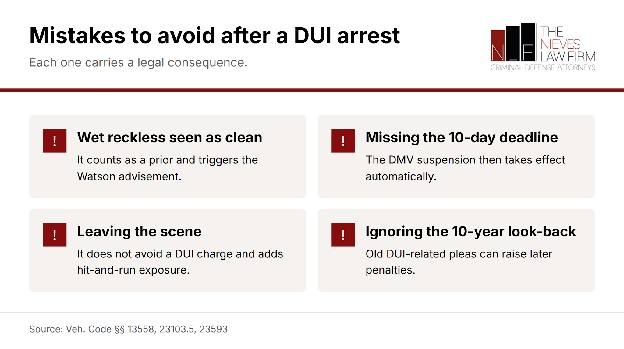
Figure 2: Most DUI mistakes come from treating one track or one plea as the whole case. Source: Veh. Code §§ 13558, 23103.5, 23593.
Frequently Asked Questions
Does Refusal Change My Suspension?
Yes, refusing a chemical test carries its own DMV suspension under Veh. Code § 13353.
A first refusal brings a one-year suspension, longer than the four-month first-offense suspension. The 10-day hearing deadline still applies.
Can An Interlock Device Restore Driving?
Possibly. An ignition interlock device can allow restricted driving and may shorten the time you go without a license. Eligibility depends on the offense, your priors and DMV proof requirements, including an SR-22 insurance filing.
Your Options After A California DUI Arrest.
A charge or a past plea does not define you. Our team at The Nieves Law Firm, APC reads the police report, tracks your DMV deadline and weighs what a plea carries, including the Watson advisement. Managing Attorney Darryl Stallworth has tried 60+ jury trials, and our offices answer phones 24 hours a day.
You have options. Request the DMV hearing within 10 days.
Review any plea terms before you sign. If a prior makes the charge a felony, read about felony DUI defense.
