


The Alameda County bail schedule sets a presumptive bail amount for each charge under Penal Code 1269b. A judge can raise it, lower it, or release you without money bail.
A call from jail lands on the whole family at once. A charge is not who you are, and it is not who the person you love is.
Jail staff use each charge’s listed bail amounts to release someone before a judge sees the case. Alameda County Superior Court judges revise the schedule each year, so a 2027 edition may not govern an earlier arrest.
The Alameda County Bail Schedule Sets Presumptive Bail.
The Alameda County bail schedule is the countywide list of presumptive bail amounts for felonies and misdemeanors. Superior Court judges adopt it under PC 1269b, and jail staff use it to release people before arraignment. Arraignment is your first court appearance on the charge.
Presumptive means a starting amount, not a final one. A judge at arraignment can set a different amount or no money bail at all.
Money bail is still California law. In 2020, voters rejected SB 10 through Proposition 25, so county schedules stayed in place.
The schedule is a court document. Find it on the Alameda County Superior Court’s official bail schedule page. We do not reprint dollar amounts here, because they change.
Judges Revise The Schedule Every Year.
A majority of Alameda County Superior Court judges must revise the schedule every year under PC 1269b(c). The edition in force on the arrest date controls, so a 2027 PDF may not apply to a 2026 arrest.
As of November 2026, check the court’s page to see whether a 2027 edition is posted. The effective date is printed on the document.
A schedule version check takes three steps:
1. Find the effective date. Open the official schedule on the Alameda County Superior Court website and read the date on its first page.
2. Match it to the arrest date. The edition in force that day is the one jail staff should have applied.
3. Save a copy. Download the PDF with its date, because the posted file can change.
Charges And Enhancements Stack.
Scheduled bail is built from the base offense line, any enhancement add-on, and any additional counts. Alameda’s own schedule instructions decide whether amounts add together or the highest line controls.
An enhancement is an added allegation that raises punishment. PC 12022(a)(1) adds one consecutive year in state prison for being armed with a firearm during a felony.
Here is an illustrative example. None of these figures come from the Alameda County bail schedule.
- Base felony charge: $50,000 (illustrative)
- PC 12022 firearm enhancement add-on: $10,000 (illustrative)
- Second felony count: $25,000 (illustrative)
Under a rule where every line adds together, scheduled bail would be $85,000. Under a rule where the highest line controls, it would be $60,000. The instructions at the front of the current edition say which rule applies.
A wobbler is an offense that can be charged as a felony or a misdemeanor under PC 17(b). At booking, it takes the felony or misdemeanor line the arresting charge supports. A misdemeanor arrest can end in cite-and-release under PC 853.6, with a written promise to appear and no bail.
Scheduled bail covers only the charge at booking. At arraignment, the prosecutor can file different or added counts. That filing decision is part of how felony charges are handled, and it can move bail up or down.
Three Decision Points Can Change Your Bail.
Bail can change at booking, at arraignment, and on a later bail review motion under PC 1289. PC 825 requires arraignment within 48 hours of arrest, excluding Sundays and holidays.
At booking, officers apply the schedule. The Alameda County Sheriff’s Office runs Santa Rita Jail in Dublin, the county’s main jail. Confirm where someone is held through the Sheriff’s inmate locator.
At arraignment, a judge hears from the prosecutor and the defense. The judge can set, raise, lower or deny bail. The custody paperwork or the court’s case lookup names the courthouse and department, and we explain what happens in court before that day.
Take a 9 p.m. Friday arrest. Saturday counts and Sunday does not, so the 48 hours run out at 9 p.m. Monday.
Court is closed then, so PC 825 extends the deadline to the end of the next court day, which is Tuesday. A Monday holiday pushes it to Wednesday.
After charges are filed, a PC 1289 motion asks a judge to revisit bail. The judge can change it on good cause.
A Bail Review Hearing Can Change Bail.
A bail review hearing is a court proceeding where a judge reconsiders bail under PC 1289. It is also called a bail reduction hearing. Either side can ask, and the judge can reduce bail, keep it, or deny it.
The defense files or requests the hearing, and the prosecutor responds. The judge decides on the PC 1275 factors and the evidence presented.
Reductions are not limited to exceptional circumstances. Current law, including In re Humphrey, requires individualized findings about the person in front of the court. We prepare clients for bail review hearings in detail, starting with the facts a judge will weigh.
PC 1275 Sets The Factors.
PC 1275 directs judges to weigh public and victim safety first. Seriousness of the offense, the defendant’s record, and the likelihood of appearing in court follow. Cal. Const. art. I, sec. 28(f)(3), part of Marsy’s Law, makes public and victim safety the primary consideration.
Each of the four factors has a factual form:
- Safety: the facts of the current charge, any weapon, and any protective order.
- Seriousness: the charge level and any enhancements.
- Record: prior convictions and how recent they are.
- Appearance: prior failures to appear, and ties that make the next court date likely.
In Re Humphrey Requires Ability-To-Pay Findings.
In re Humphrey (2021) 11 Cal.5th 135 holds that courts must consider ability to pay and nonfinancial conditions. Detaining someone only because they cannot afford bail is unconstitutional.
Detention requires a finding, by clear and convincing evidence, that no lesser condition can protect safety or secure appearance. Lesser conditions include supervision and electronic monitoring.
Proof of means and stability carries weight here. That means income records, employment letters, proof of residence and community ties.
Three Outcomes Are Possible.
A bail review ends in one of three ways: reduced bail or own-recognizance release with conditions, money bail kept, or detention without bail. Own recognizance (OR) release under PC 1318 means release on a signed promise to appear.
- Reduced bail or OR with conditions: the defense brings employment letters, residence proof, income records and family ties, and offers conditions such as supervision or electronic monitoring.
- Money bail kept: the prosecutor points to the charge facts or the record, and the judge finds the amount fits the person’s means.
- Detention without bail: the prosecutor brings evidence of violence, threats or prior failures to appear, and the defense answers with proof of stability and workable conditions.
No-bail detention rests on Cal. Const. art. I, sec. 12. It covers capital crimes where the facts are evident or the presumption great. It also covers violent or sexual-assault felonies with that same proof, plus clear and convincing evidence of a substantial likelihood that release would result in great bodily harm.
Felonies where the person threatened great bodily harm and is likely to carry it out also qualify.
Gather pay stubs, an employer letter, a lease or utility bill, and the names of people who can speak for you.
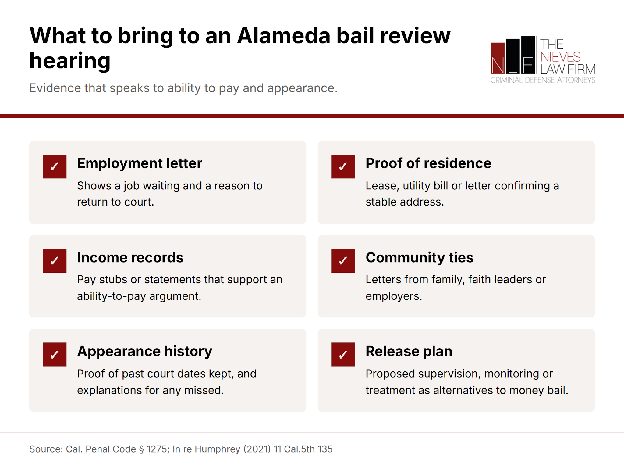
Figure 1: Documents on stability and income give the judge reasons to choose conditions over money bail. Source: Cal. Penal Code § 1275; In re Humphrey (2021) 11 Cal.5th 135.
Cash Bail And Surety Bonds Cost Differently.
Cash bail is the full amount deposited with the court and returned at case end, less fines and fees. A surety bail bond costs a premium, typically 10%, that is never refunded.
On $50,000 bail, a bail bond premium is $5,000. That money is gone, whatever happens in the case. A $50,000 cash deposit comes back at exoneration, less any fines and fees the court applies.
Now say a bail review hearing cuts bail to $25,000. A new bail bond would cost $2,500. The $5,000 already paid is not refunded.
| Attribute | Cash bail | Surety bail bond |
|---|---|---|
| Paid up front | Full bail amount to court | Premium, typically 10% |
| Refund at case end | Yes, less fines and fees | Premium never refunded |
| If bail is later reduced | Court returns the excess | Premium already paid stays lost |
| Who is at risk | Depositor | Bond agent and cosigners |
| If defendant misses court | Deposit can be forfeited | Full amount can be demanded |
Figure 2: Cash returns at case end less fines and fees, while a bond premium is gone once paid. Source: Cal. Penal Code §§ 1269b, 1305, 1306.
The common mistake is buying a bail bond on scheduled bail hours before arraignment, when a judge may reduce bail or grant OR release. Families in that spot can weigh their options when bail is unaffordable first.
Scheduled Bail Does Not Always Release You.
A hearing requirement, a hold, a warrant or a higher requested amount can override scheduled bail. There are five cases, each with its own decision-maker:
- PC 1270.1 cases: serious felonies under PC 1192.7(c) (residential burglary excepted), violent felonies under PC 667.5(c), domestic violence, stalking and certain protective-order violations require a hearing in open court, with notice to the prosecutor, before release. A judge decides.
- Probation or parole holds: posting bail on the new charge does not lift the hold. The probation department or court controls a probation hold, and state parole controls a parole hold.
- Out-of-county or bench warrants: the bail on the warrant controls, not the Alameda schedule. The issuing court decides.
- Immigration holds: a federal detainer sits outside bail. California law limits when local jails honor detainers, and federal authorities decide custody after any transfer.
- PC 1269c requests: an officer can ask a judge for bail above the schedule. The judge decides, and the defense can ask under the same section for lower bail or OR release.
Missing Court Triggers Bail Forfeiture.
If a defendant misses court, the judge declares bail forfeited and issues a bench warrant. Under PC 1305 and 1306, the surety or depositor generally has 185 days to produce the defendant or move to vacate the forfeiture.
The 185 days is 180 days plus 5 for mailing the forfeiture notice under PC 1305. If that period ends without relief, PC 1306 allows judgment for the full bail. Bail bond cosigners and cash depositors both have the full amount at risk.
When the case ends with every appearance made, the court exonerates bail. Cash returns to the depositor, less fines and fees, and the bail bond premium is never refunded. Knowing what to do after a missed court date protects both the money and the case.
Frequently Asked Questions
Can Someone Else Post My Bail?
Yes, a relative or friend can post cash bail or arrange a bail bond. The court refunds cash to the depositor at exoneration, so that person also carries the forfeiture risk. Anyone posting should understand those duties before signing.
Is Bail Refunded If Charges Drop?
Yes for cash bail. It is exonerated and returned to the depositor, less any fines or fees, when charges are dismissed or the case ends. A bail bond premium is not refunded, and timing depends on the court’s exoneration order.
What Is Own Recognizance Release?
Own recognizance release under PC 1318 lets a person go free on a written promise to appear, usually with conditions. A judge decides at arraignment or at a bail review hearing. It is not available in every case.
We Prepare Before Your Bail Hearing.
The amount on the Alameda County bail schedule is a starting point. The hearing is where your facts, your ties and workable conditions get heard. At The Nieves Law Firm, APC, you meet intake first, then an attorney, with legal support behind you at every hearing.
Jo-Anna Nieves has taught Trial Advocacy at Stanford Law School since 2018. Darryl Stallworth has tried more than 60 jury trials. We Take The “Criminal” Out Of Criminal Defense.® That is our promise in how you are treated.
Our page on current bail schedules is the next place to look. For people who have too much to lose.
