


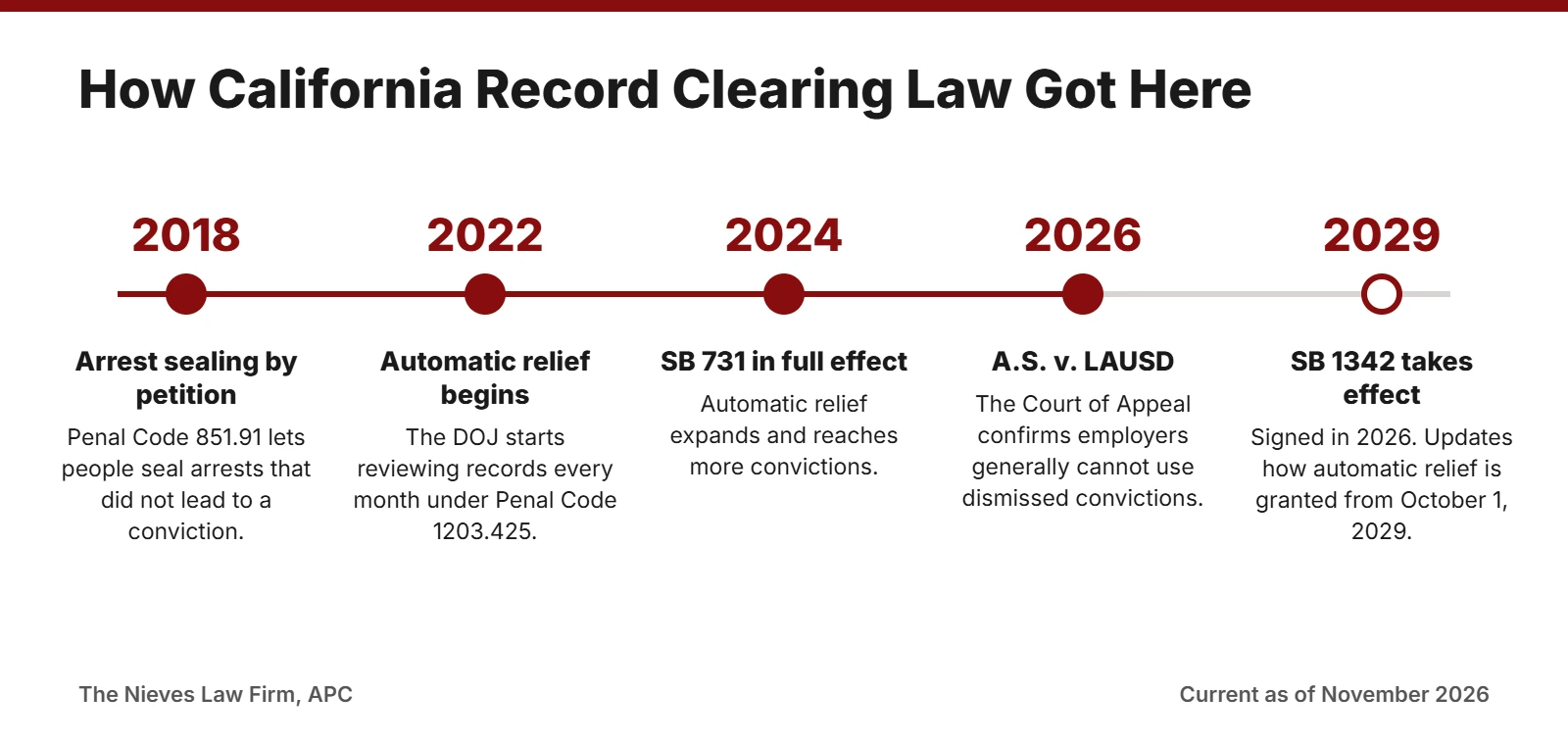
Last updated November 10, 2026. Reflects California’s automatic record relief rules, the September 2026 decision in A.S. v. Los Angeles Unified School District, and SB 1342 (signed September 27, 2026).
Expunging and sealing are two different things in California, and for a misdemeanor conviction usually only one of them applies. A conviction is cleared through a court dismissal, which most people call an expungement. Sealing is mainly for arrests that never led to a conviction.
The difference decides which petition you file, what a background check shows, and what you still have to disclose. The criminal defense attorneys at The Nieves Law Firm handle both.
| Expungement (dismissal) | Arrest record sealing | |
|---|---|---|
| Applies to | A conviction | An arrest with no conviction |
| Law | Penal Code 1203.4 and 1203.4a | Penal Code 851.91 |
| What happens | The plea or verdict is set aside and the case is dismissed | The arrest is treated as if it did not occur |
| Is the record destroyed? | No. It shows as dismissed | No. It is closed to the public |
| Who can still see it | Courts, law enforcement, and licensing agencies | You and criminal justice agencies |
| When you can file | After probation ends, or one year after judgment | Once charges can no longer be filed or refiled |
What Expungement Means in California
California does not erase convictions. An expungement is a dismissal: the court lets you withdraw your plea or sets aside the verdict, enters a not guilty plea, and dismisses the case.
Your record is then updated to show the dismissal, and you are released from most penalties and disabilities that came with the conviction. Which statute applies depends on whether you were sentenced to probation.
If You Were on Probation
A petition under Penal Code 1203.4 applies. The court must grant it if you completed probation and you are not serving a sentence, on probation, or facing charges in another case.
If you had a violation or did not finish every term, the judge can still grant the dismissal in the interests of justice.
If You Were Not on Probation
Penal Code 1203.4a applies. You can file one year after the date of judgment if you completed your sentence and are not charged with a new crime.
Misdemeanors That Do Not Qualify
A small group of offenses, mostly sex offenses involving minors, cannot be dismissed this way. For DUI and certain other driving offenses, the judge has discretion to grant or deny the petition.
Unpaid restitution is no longer a reason to deny a dismissal. That changed in 2022 under SB 1106.
What Sealing Means in California
Sealing applies to an arrest that did not end in a conviction. That includes arrests where no charges were filed, the case was dismissed, you were acquitted, or a conviction was later vacated.
Under Penal Code 851.91, most people in that position are entitled to have the arrest sealed. Once it is sealed, the arrest is treated as if it did not occur, and the record can be released only to you or a criminal justice agency.
There is one main exception. If the record shows a pattern of domestic violence, child abuse, or elder abuse arrests, the judge decides whether sealing serves the interests of justice.
Can a Misdemeanor Conviction Be Sealed?
Generally, no. A misdemeanor conviction is dismissed, not sealed. The exceptions are narrow: a misdemeanor committed before age 18 can be sealed under Penal Code 1203.45 after a dismissal, and juvenile court records have their own sealing rules.
A 2026 bill, AB 2384, would have let courts seal many convictions after four years. It stalled in the Senate in August 2026 and is not law.
Which One Applies to Your Case?
Start with the outcome of the case, not the charge. A conviction points to a dismissal. An arrest without a conviction points to sealing.
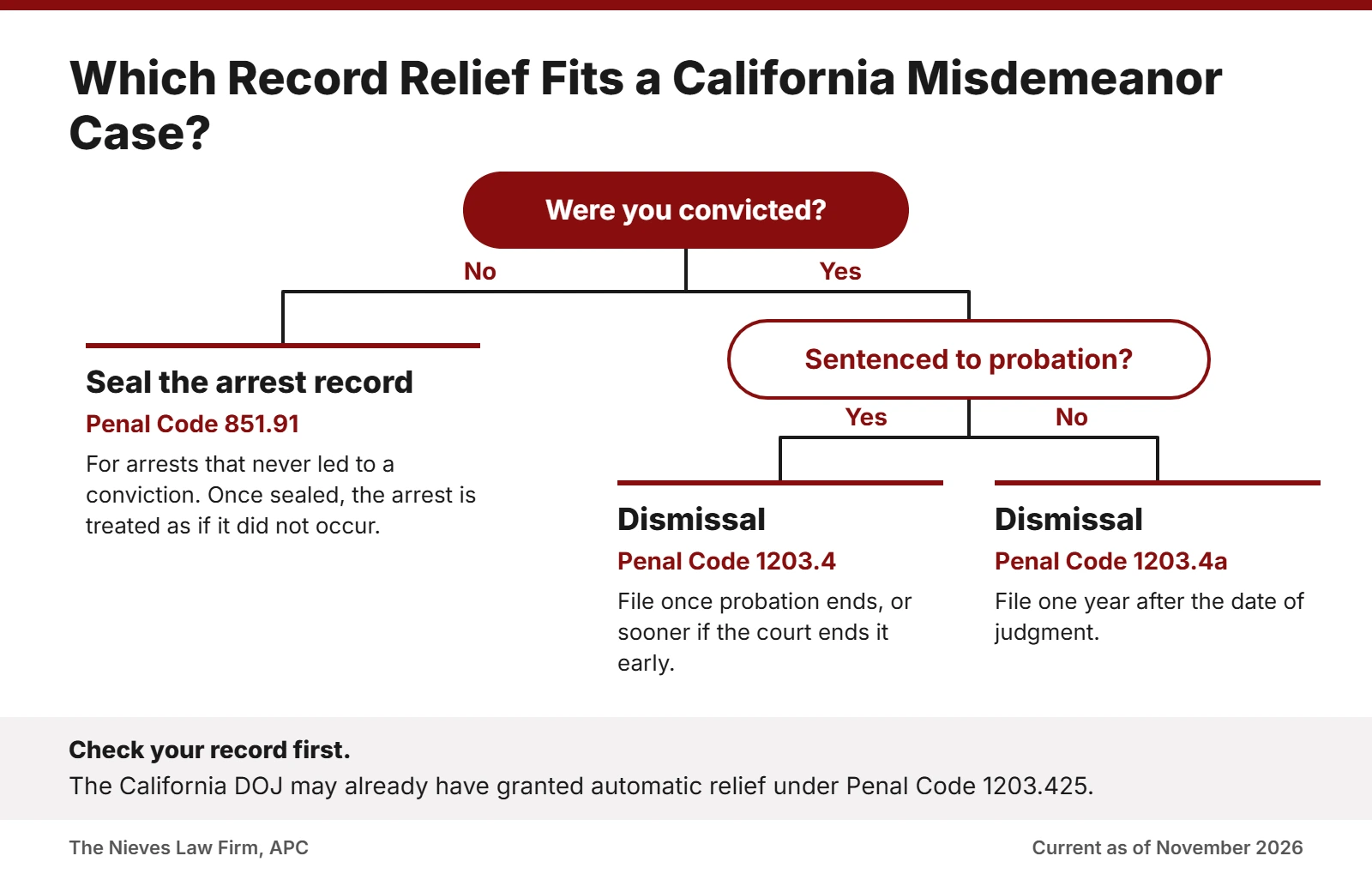
Many people have both on their record from different cases. Each case gets its own petition under its own statute.
Automatic Record Relief in California
You may not need to file anything. Under Penal Code 1203.425, the California Department of Justice reviews statewide records every month and grants relief to eligible convictions without a petition.
A misdemeanor conviction from 1973 or later generally qualifies if you completed probation without a revocation. If you had no probation, it qualifies once you completed the sentence and a year has passed since judgment.
Automatic relief does not apply if you must register as a sex offender, are on supervision, are serving a sentence, or have pending charges. Misdemeanor arrests get similar automatic relief under Penal Code 851.93 when the charge was dismissed, you were acquitted, or a year passed with no case filed.
Why People Still File a Petition
The DOJ does not notify you when relief is granted, and records with missing or unclear court data can be skipped. The only way to know is to request a copy of your own record from the DOJ.
A petition also reaches cases the automatic process does not, such as a conviction with a probation violation. And it gives you a signed court order you can show an employer or licensing agency.
What Is Changing After 2026
SB 1342 was signed on September 27, 2026. It changes how the DOJ decides eligibility, for example by presuming there are no pending charges once three years pass with no new activity on a record.
Those changes do not take effect until October 1, 2029. The rules described here are the ones that apply through 2027.
What Changes After a Dismissal
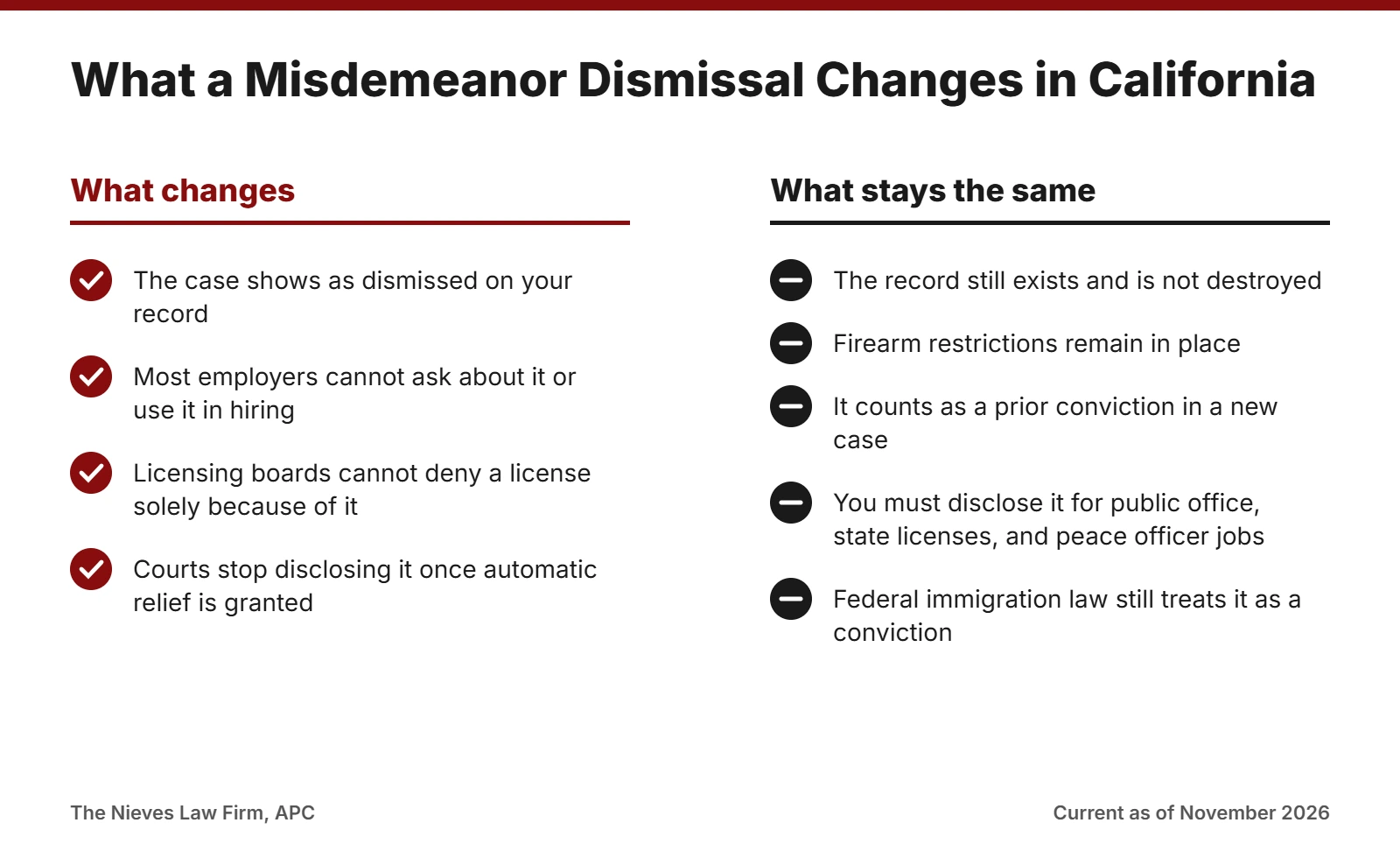
A dismissal does not make the case disappear, but it changes how the conviction can be used against you.
Employment
Under Labor Code 432.7 and the Fair Chance Act, employers generally cannot ask about or rely on a conviction that has been dismissed or sealed.
On September 22, 2026, the California Court of Appeal applied that rule in A.S. v. Los Angeles Unified School District. Two applicants had been turned away over misdemeanors dismissed under Penal Code 1203.4. The court held that even an employer required to run background checks cannot use a dismissed conviction unless a specific law allows it.
Professional Licenses
Under Business and Professions Code 480, a state licensing board cannot deny a license solely because of a conviction that was dismissed under Penal Code 1203.4 or 1203.4a. You still have to disclose the conviction if the application asks.
What Does Not Change
- The record still exists. It shows the conviction and the dismissal.
- Firearm restrictions tied to the conviction stay in place.
- The conviction counts as a prior if you are charged with a new offense.
- You must disclose it on applications for public office, a state or local license, or a peace officer position.
- Federal immigration law still treats it as a conviction. That problem usually calls for a motion to vacate instead.
How to Clear a Misdemeanor Record
- Get your record. Request your criminal history from the California DOJ and pull the court docket for each case.
- Check for automatic relief. Your DOJ record shows whether relief has already been granted.
- Identify the right statute. Penal Code 1203.4, 1203.4a, or 851.91, based on the outcome of the case.
- File the petition. Form CR-180 for a dismissal or CR-409 to seal an arrest, in the county where the case was handled.
- Serve the prosecutor. The district attorney gets notice and a chance to respond.
- Attend the hearing if one is set. Many petitions are decided on the paperwork.
- Confirm the update. After the order is signed, check your record again to make sure the DOJ and the court reflect it.
Timing varies by county and by how complete the record is. We cover the usual range in our answer on how long an expungement case takes.
Talk to The Nieves Law Firm About Clearing Your Record
Whether a case calls for a dismissal, a sealing petition, or nothing at all because relief was already granted depends on the record itself. Our expungement attorneys can review your record, confirm what has and has not been cleared, and file the petitions that apply.
Contact The Nieves Law Firm to discuss your record with a California criminal defense attorney.
